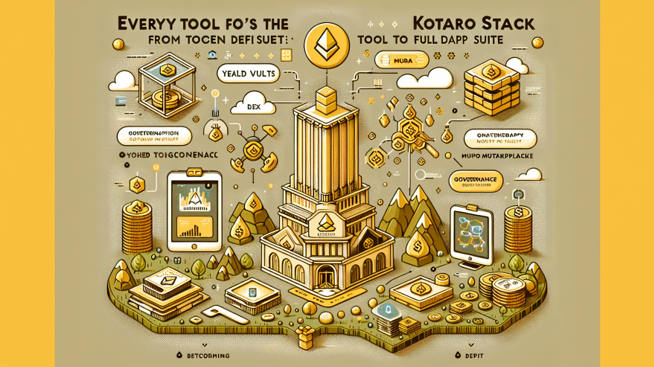
# Every Tool in the KOTARO Stack: From Token to Full dApp Suite
[](https://postimg.cc/2bgkJJk9)
<p>Community finance doesn't get the press that VC-backed mega-protocols do. That's fine. ChaiFi isn't chasing headlines — it's building a full DeFi toolkit on <strong><a href="https://dexscreener.com/bsc/0xc9586c1ad3b01323a05b6f39367d64548190f95b">CHAI</a></strong> where the community actually decides what gets built next. And piece by piece, CHAI has grown from a single token into something that looks a lot like a self-contained financial ecosystem.</p>
<p> </p>
<h2><strong>So what is ChaiFi, exactly?</strong></h2>
<p> </p>
<p>Think of it as DeFi infrastructure designed for regular people, not whales. The name's a nod to the communal act of sharing chai — applied here to shared financial tools on BNB Chain. CHAI is the token that ties everything together: governance votes, fee payments, staking rewards, premium feature access. It's not a sit-and-hold token. The more the ecosystem grows, the more doors CHAI opens.</p>
<p> </p>
<p>Here's the thing that makes ChaiFi a bit unusual: the team didn't start with a whitepaper full of grand promises and then work backward. They asked the community what they actually needed and built that. Bottom-up development sounds simple, but almost nobody does it. Features ship because real users asked for them.</p>
<p> </p>
<h2><strong>The dApp lineup</strong></h2>
<p><strong> </strong></p>
<h3><strong>Their own DEX</strong></h3>
<p> </p>
<p>ChaiFi runs a native DEX module tuned for CHAI pairs. You can still trade CHAI on PancakeSwap — nobody's stopping you — but the in-house DEX cuts fees for ecosystem participants and routes trades to minimize slippage on CHAI-specific pairs.</p>
<p> </p>
<p>It also doubles as a sandbox. Limit orders, TWAP execution, conditional swaps — all prototyped here before rolling out to other tokens. Think of it as the test kitchen.</p>
<p> </p>
<h3><strong>Yield vaults</strong></h3>
<p> </p>
<p>The vault system auto-compounds yields from liquidity provision and staking across multiple protocols. You deposit CHAI or CHAI LP tokens, and the vaults handle the harvesting and reinvesting. Gas costs get split across everyone in the vault, so you don't need a fat stack to run sophisticated yield strategies.</p>
<p> </p>
<p>These vaults are CHAI-centric by design. Strategies get picked based on how they strengthen the CHAI ecosystem long-term, not just whatever has the flashiest APY this week.</p>
<p> </p>
<h3><strong>Community treasury and grants</strong></h3>
<p> </p>
<p>A chunk of protocol revenue goes into a community treasury. CHAI holders vote on how it gets spent — developers submit grant proposals, creators pitch ideas, community organizers request funding. No centralized committee making decisions behind closed doors.</p>
<p> </p>
<p>Past grants have funded educational content, analytics dashboards, trading tools, and even regional meetups. Value generated by the protocol flows back to the people building around it.</p>
<p> </p>
<h3><strong>NFTs in the mix</strong></h3>
<p> </p>
<p>There's an NFT marketplace where you can mint, trade, and collect digital art using CHAI. Might seem like an odd fit for a DeFi protocol, but it's intentional. NFTs expand what CHAI is useful for beyond pure finance and give the community cultural touchstones to rally around.</p>
<p> </p>
<p>Membership NFTs aren't just collectibles either — they unlock better governance tiers and staking rewards. So the financial and cultural layers feed into each other.</p>
<p> </p>
<h2><strong>Governance that actually works</strong></h2>
<p> </p>
<p>ChaiFi doesn't just do token-weighted voting and call it a day. There's a participation score factoring in your voting history, whether you've submitted proposals, community contributions, and how long you've been staking. Big bags alone don't dominate decisions.</p>
<p> </p>
<p>Proposals go through a full lifecycle: discussion, temperature check, formal vote, implementation. Each phase needs minimum participation before it moves forward. The point is that major decisions should reflect real consensus, not apathy.</p>
<p> </p>
<h2><strong>Liquidity you can verify</strong></h2>
<p> </p>
<p>ChaiFi's team locked their WBNB/CHAI liquidity on <strong><a href="https://mudra.website">liquidity locker</a></strong>. That's an on-chain commitment — not a blog post promise — that trading liquidity stays put regardless of what markets do.</p>
<p> </p>
<p>Anyone can pull up the lock and verify the terms directly on the blockchain. No trust required. In a space where anonymous teams regularly vanish after draining their liquidity pools, a verifiable lock like this is one of the clearest signals that a team is serious about sticking around.</p>
<p> </p>
<h2><strong>The flywheel effect</strong></h2>
<p> </p>
<p>More community members lead to more governance participation. Better governance produces better features. Better features attract more members. Protocol revenue feeds the treasury, which funds grants, which produce tools and content that bring in new users.</p>
<p> </p>
<p>It's hard to get this loop spinning, but once it's moving, it's powerful. Community-first protocols generate organic enthusiasm that paid marketing can't touch. When people feel real ownership over where a protocol is headed, they become its best evangelists.</p>
<p> </p>
<h2><strong>Where ChaiFi stands</strong></h2>
<p> </p>
<p>BNB Chain DeFi is crowded. But the community-finance corner? Still surprisingly underserved by teams that actually deliver. ChaiFi bundles a DEX, vaults, governance, NFTs, and grants into one cohesive ecosystem — way more convenient than stitching together five different protocols yourself.</p>
<p> </p>
<p>If you're evaluating CHAI, keep an eye on governance participation rates, treasury growth, and whether people are using the full suite of tools or just one product. Healthy community protocols show balanced engagement across the board. That's what'll determine ChaiFi's trajectory.</p>
<p> </p>